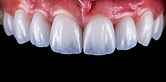
Tooth wear is common but often underestimated. Many people notice it only when teeth begin to look shorter, become sensitive or the bite feels different. At our dental practice in Basel, two important forms of mechanical tooth wear are abrasion and attrition. Both remove tooth structure, but their causes differ and treatment should therefore be directed at the individual mechanism.
Tooth wear describes non-carious loss of enamel and dentine. The main mechanisms are abrasion, attrition and erosion, and more than one can occur at the same time. This page focuses on abrasion and attrition because they can affect both function and appearance.

Abrasion
is mechanical wear caused by an external object or habit. Possible contributors include aggressive toothbrushing, abrasive toothpaste, inappropriate use of interdental aids or repeated contact from an appliance or prosthesis. Clinical signs may include smooth polished surfaces, cervical defects and sensitivity where dentine is exposed. Cervical lesions are often multifactorial, so brushing should not automatically be assumed to be the only cause.
Attrition
is wear caused by tooth-to-tooth contact. It can be associated with bruxism or other repeated functional or parafunctional contacts. Typical signs include flattened occlusal surfaces, shortened incisal edges, matching wear facets and sometimes cracks or restorative complications. Extensive generalised wear can reduce tooth height, although the jaw and teeth may partly compensate over time; changes in vertical dimension and temporomandibular symptoms should therefore be assessed rather than assumed.


When vertical tooth height is substantially reduced, the lower facial third can appear shorter and lip or cheek support may change. Facial lines such as the nasolabial fold or marionette lines are influenced by many age-related and anatomical factors, so dental wear is only one possible contributor.

Loss of vertical tooth height
Without significant loss of vertical dimension:

With reduced vertical dimension:

Edentulous patient:

Diagnosis
Diagnosis of abrasion and attrition is based on a comprehensive clinical assessment. We may use intraoral scans, clinical photographs, functional examination and a detailed history to document the pattern and monitor change over time. Serial digital records are particularly useful when it is unclear whether wear is active or stable. A
CBCT scan is not a routine diagnostic method for abrasion or attrition; it is reserved for separate questions involving roots, bone or other three-dimensional anatomy when clinically justified.
Treatment depends on the cause, severity and individual functional and aesthetic needs. For abrasion, the first step is to reduce the contributing mechanical factor – for example by modifying brushing technique, using a soft toothbrush and appropriately low-abrasive toothpaste, or adjusting an appliance that is causing trauma. When structural defects require restoration, composite, veneers, partial-coverage ceramic restorations or crowns may be considered according to the amount of remaining tooth structure.
For attrition, management begins by determining whether wear is active and what is driving it. An individually made Michigan-type splint can protect teeth and restorations from direct nocturnal grinding contact, but it does not necessarily stop bruxism itself. If substantial tooth structure has been lost, additive composite or ceramic reconstruction may restore form and function. Increasing the vertical dimension may be appropriate in selected rehabilitations and is usually tested with a reversible diagnostic or provisional phase before definitive treatment.
Patients can help reduce further damage by avoiding destructive habits, using a non-traumatic brushing technique, wearing a prescribed splint as instructed and addressing daytime clenching or relevant sleep and stress factors. Periodic photographs or scans can show whether wear is progressing.
Progressive tooth wear can eventually lead to sensitivity, cracks, fractures, restorative complications and aesthetic concerns. Earlier recognition often allows more conservative management, but not every worn tooth requires restorative treatment.
Frequently asked questions about abrasion and attrition
What is the difference between abrasion and attrition?
Abrasion is wear caused by an external mechanical factor, whereas attrition results from tooth-to-tooth contact. In practice, several wear mechanisms can coexist.
Do abrasion and attrition always continue if untreated?
Not necessarily. Some wear becomes stable once the cause changes, while active habits or ongoing mechanical exposure can cause progression. Monitoring helps determine whether treatment is needed.
Can worn teeth be painful?
Yes. Exposed dentine, cracks, pulpal irritation or associated muscle and joint problems can cause symptoms, although many worn teeth remain symptom-free.
Does a night guard help with attrition?
A well-designed occlusal splint can protect tooth surfaces and restorations from direct grinding contact and may help selected patients with muscle symptoms. It does not reliably eliminate the underlying bruxism activity.
When is an increase in bite height necessary?
Only when restorative space, function, tooth structure and the overall rehabilitation plan justify it. Reduced tooth height alone does not automatically mean the bite must be raised.
Can worn teeth be restored aesthetically?
Yes. Composite and ceramic restorations can rebuild form and function in appropriate cases, ideally using an additive and tooth-preserving approach whenever possible.
If you notice increasing wear, shorter teeth, sensitivity or repeated fractures, we can document the pattern in Basel and determine whether the process is active, what is contributing to it and whether monitoring, protection or restorative treatment is appropriate.