Non-Surgical Periodontal Treatment

Non-Surgical Periodontal Treatment in Basel
In brief: non-surgical periodontal treatment
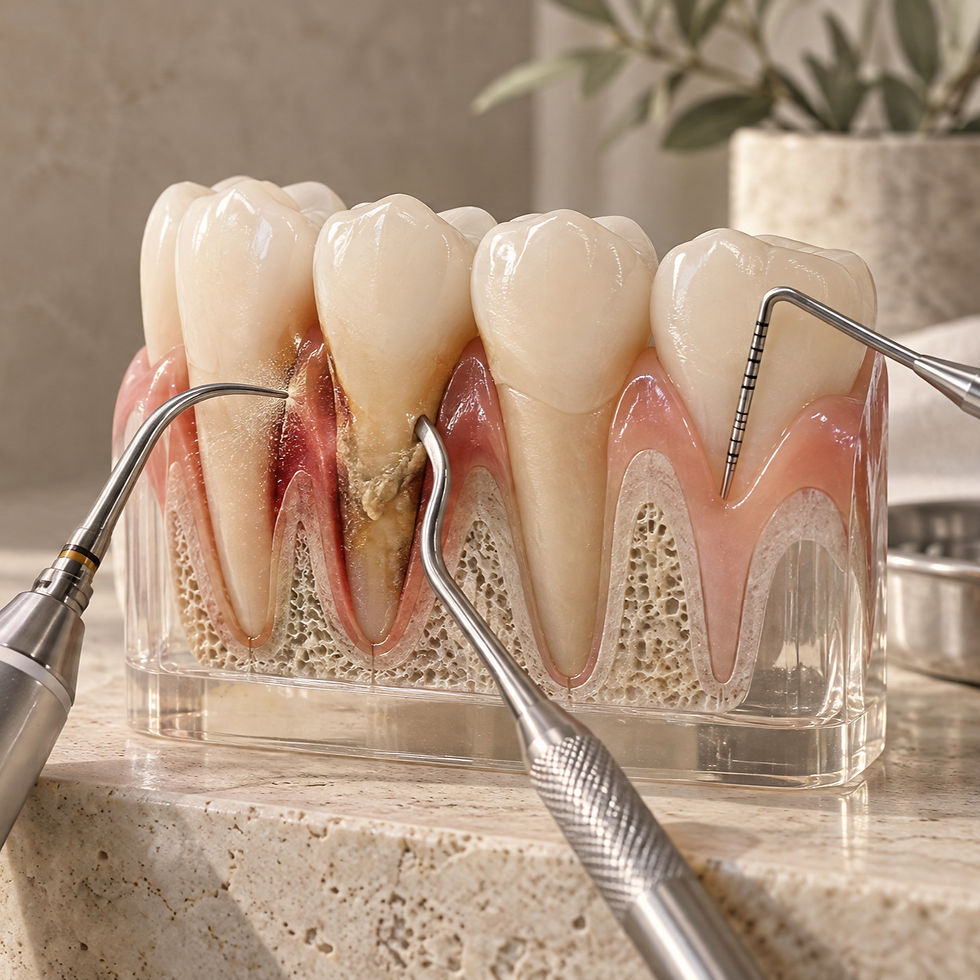
Non-surgical periodontal treatment, including subgingival instrumentation, is the first-line treatment for periodontitis – a chronic inflammatory disease that damages the tooth-supporting tissues and can lead to tooth mobility and tooth loss if it progresses untreated.
The aim is to disrupt and remove subgingival biofilm and calculus so that inflammation can decrease and the periodontal tissues can stabilise.
In our Basel practice, treatment may include ultrasonic and hand instrumentation, low-abrasive air polishing where appropriate, magnification and individual oral-hygiene instruction. Additional measures are used only when clinically indicated.
Signs that may indicate periodontal treatment is needed
bleeding gums
persistent bad breath
gum recession
sensitive teeth or teeth that appear longer
tooth mobility or a feeling of pressure
deposits below the gumline
discomfort when chewing
Periodontitis is often painless for a long time, which is why regular periodontal screening and risk-based follow-up are important.
Treatment Process
1. Diagnosis & periodontal assessment
Periodontal charting, including pocket depths, bleeding and recession
Dental X-rays where indicated to assess bone levels
Assessment of individual risk factors and, in selected cases, additional diagnostic tests
2. Biofilm management / initial phase
Professional dental cleaning and personalised oral-hygiene instruction
Air polishing with a low-abrasive powder where appropriate to remove biofilm
3. Non-surgical periodontal treatment (SRP)
Cleaning of periodontal pockets with ultrasonic instrumentation
Root-surface debridement where deposits are present
Selective hand instrumentation for complex root anatomy
Adjunctive measures may be considered in selected cases, but they do not replace thorough mechanical periodontal treatment and effective daily plaque control.
4. Reevaluation after healing, usually around 6–12 weeks
Reassessment of pocket depths, bleeding and other inflammatory parameters
Assessment of the response to treatment
Decision whether supportive care is sufficient or further periodontal treatment is needed
5. Supportive periodontal care
Recall intervals often around 3–4 months after active periodontitis treatment, then adjusted to individual risk
Long-term maintenance is a key part of preserving periodontal stability
Potential Benefits and Treatment Goals
Conservative and minimally invasive
Evidence-based first-line treatment for periodontitis
Reduces periodontal inflammation and bleeding when combined with effective home care
Supports fresher breath, healthier gums and easier oral hygiene
Can reduce or limit the need for periodontal surgery in suitable sites
Verbessert systemische Gesundheit (Herz-Kreislauf, Diabetes)*
* Periodontitis is associated with several systemic diseases; association does not mean that periodontal treatment prevents or cures those diseases.
Scientific Context
SRP is the established basis of initial periodontal therapy
Clinical evidence supports reductions in pocket depth and bleeding after thorough non-surgical instrumentation.
Cobb CM. (2002). J Periodontol. PMID: 11846100
Low-abrasive air polishing can support biofilm management
Erythritol-based powders have been investigated as a gentle adjunct for professional biofilm removal.
Hägi TT et al. (2013). Clin Oral Investig. PMID: 22581462
Photodynamic therapy as an adjunct
Studies have investigated photodynamic therapy as an adjunct to mechanical debridement; any additional benefit appears indication- and protocol-dependent.
Azarpazhooh A. et al. (2010). J Periodontol. PMID: 20450357
Regular supportive care is important for long-term periodontal stability
Long-term studies show substantially better outcomes in patients who adhere to structured maintenance compared with irregular attendance.
Axelsson P, Lindhe J. (1981). J Clin Periodontol. PMID: 6947997
Periodontitis & systemic health
Associations with diabetes and cardiovascular disease are well documented, although causal pathways and the effect of treatment on systemic outcomes differ by condition.
Tonetti MS et al. (2013). J Clin Periodontol. PMID: 23574467
Costs and Individual Treatment Planning
(individual, depending on pocket depth, number of areas treated and treatment time)
Treatment | Indicative Range |
Periodontal charting / diagnosis | 80–150 |
Non-surgical periodontal treatment (SRP, per quadrant) | 180–300 |
Full-mouth SRP, depending on treatment plan | 600–1’200 |
Adjunctive treatment, if indicated | 80–200 |
Follow-up & reevaluation | 100–180 |
Frequently asked questions
Is scaling and root planing painful?
Local anaesthesia can be used where needed. Most patients tolerate treatment well, although temporary tenderness or sensitivity may occur afterwards.
How long does the result last?
Periodontitis is a chronic condition. Good home care, control of risk factors and regular supportive periodontal maintenance are essential to keep it stable over time.
Can periodontitis be cured?
Active inflammation can often be brought under control, but long-term
When is periodontal surgery necessary?
Surgery may be considered for persistent deep or anatomically complex pockets that cannot be adequately managed with non-surgical treatment alone.
Summary
Non-surgical periodontal treatment is the foundation of periodontitis therapy. It aims to control inflammation, preserve teeth where possible and establish conditions for long-term periodontal stability.
If you notice bleeding gums, persistent bad breath or increasing tooth mobility, we can assess your periodontal health in Basel and explain the appropriate treatment and maintenance plan.
Diagnostics and Planning
Planning is based on a structured periodontal assessment. Relevant factors include signs of inflammation, probing depths, bleeding, recession, bone support, oral hygiene and individual risk factors. Treatment and maintenance are tailored accordingly.
Limitations, Risks and Alternatives
Treatment success depends substantially on control of inflammation, effective home oral hygiene and regular supportive maintenance. Smoking, diabetes, pronounced defects or advanced bone loss can affect the prognosis. Not every starting situation can be fully reconstructed anatomically.
Non-surgical periodontal treatment in Basel: experience and clinical context
In our Basel practice, systematic diagnostics are combined with a clear tooth-preservation strategy. Periodontal and reconstructive aspects are considered together; complex periodontal-surgical questions are managed, where appropriate, in collaboration with suitably specialised colleagues.More about Dr Thomas Gasser’s training and qualifications.
Related Topics on Our Website
Depending on the individual situation, Periodontal Surgery, Bad breath (halitosis) or Dentalhygiene may also be relevant.You can find further dental services in Basel in our treatment overview.
Literature and Scientific Context
PubMed PMID 32594621 – Non-surgical periodontal therapy effectively improves patient-reported outcomes: A systematic review
PubMed PMID 40347039 – The Effect of Non-Surgical Periodontal Therapy on Subgingival Microbiota: A Systematic Review and Meta-Analysis
The selected literature provides scientific context. Which findings are relevant to a specific treatment depends on the diagnosis, the starting situation, individual risks and the treatment goals agreed together.


Other treatments