Dental Cyst Removal

Dental Cyst Removal in Basel
In brief: Dental Cyst Removal
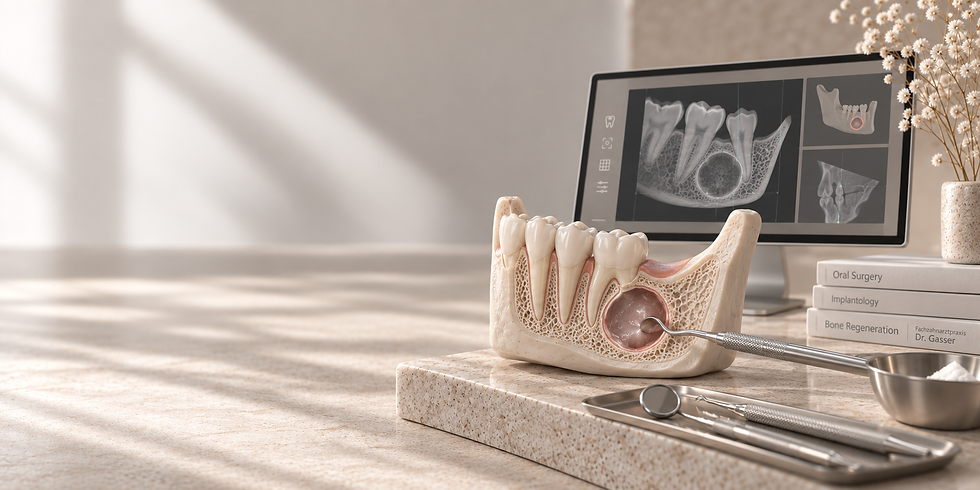
Jaw cysts are pathological cavities, often fluid-filled, that can develop within the jaws and may remain symptom-free for a long time. Odontogenic cysts can be associated with inflamed or non-vital teeth, impacted teeth or developmental processes.
Most jaw cysts are benign, but some can enlarge, displace bone or teeth, become infected or mimic other lesions. They therefore require appropriate diagnosis and a management plan based on type, size, location and symptoms.
At our practice in Basel, clinical examination and appropriate imaging, including CBCT when indicated, are used to assess the lesion. Surgical treatment is planned to preserve surrounding tissues and important anatomical structures.
Common causes and types of jaw cysts
Radicular/periapical cyst: a common odontogenic cyst associated with chronic inflammation around the root tip of a non-vital tooth.
Dentigerous cyst: develops around the crown of an unerupted or impacted tooth, including wisdom teeth.
may remain in the jaw after extraction of a tooth associated with a previous cystic lesion
a distinct lesion with a higher recurrence risk and a need for structured follow-up
Non-odontogenic cysts: less common, for example a nasopalatine duct cyst.
Many odontogenic cysts are associated with inflammatory or developmental processes. An exact diagnosis requires clinical, radiographic and, when tissue is removed, histopathological assessment.
Symptoms – often subtle
Pressure or swelling
Displacement of nearby structures
Tooth mobility or pain as a lesion enlarges
Incidental finding on a radiograph or CBCT scan
Treatment options
1. Cystectomy / enucleation (complete removal)
For many suitable cysts, the lesion can be removed surgically in one procedure. The exact approach depends on diagnosis, size and anatomical relationships.
2. Marsupialisation / decompression
A cyst may be opened and decompressed when immediate complete removal would carry unnecessary risk, for example with very large lesions.
3. Apicoectomy (when indicated)
If a cystic lesion is associated with the root of a tooth, treatment may sometimes be combined with
4. Bone regeneration
Depending on defect size and anatomy, healing may be supported with grafting materials or autogenous bone in selected cases. The role of adjuncts such as PRF depends on the indication and should not be considered essential for all cyst defects.
Treatment Process
3D diagnostics (CBCT) when indicated: assessment of location, extent and relationship to neighbouring structures
selection of a conservative surgical access and appropriate technique
Procedure under local anaesthesia: careful removal or decompression of the lesion according to its type and size
smoothing, cleaning and, where appropriate, support of bone healing
removed tissue is generally submitted for microscopic examination
clinical and radiographic review according to the diagnosis and size of the lesion
Removed pathological tissue is generally submitted for histopathological examination to confirm the diagnosis and exclude less common lesions.
Scientific Context
Radicular cysts are among the most common odontogenic cysts:
Shear M. et al. (2007). Cysts of the Oral and Maxillofacial Regions. PMID: 17653045
Enucleation is a common definitive treatment for many odontogenic cysts, but the appropriate approach depends on cyst type, size and anatomy; larger lesions may sometimes be decompressed or marsupialised before or instead of complete removal.
Ramachandra S. et al. (2014). J Oral Maxillofac Pathol. PMID: 25364179
Costs and Individual Treatment Planning
(Depending on size, location, surgical complexity and any reconstruction; an individual estimate is provided in advance.)
Treatment | Indicative Range |
Cystectomy / enucleation (standard) | 350 – 800 |
Complex cyst surgery, including root-end surgery where indicated | 600 – 1’200 |
Bone grafting / defect augmentation | 150 – 450 |
CBCT / 3D diagnostics | 150 – 400 |
Frequently asked questions
Is a jaw cyst dangerous?
Many cysts are benign, but some can enlarge, affect bone or neighbouring teeth, become infected or recur. Proper diagnosis is therefore important.
Does the procedure hurt?
The procedure is performed with local anaesthesia, so pain is usually well controlled during surgery. Temporary swelling or postoperative discomfort can occur.
Does the affected tooth always have to be removed?
Not necessarily. Teeth are removed only when they cannot be predictably preserved or when removal is required for treatment of the lesion. In many cases, teeth can be retained with endodontic treatment and, when indicated, apical surgery.
Can a cyst come back?
Recurrence risk depends on the cyst type. Some lesions, particularly odontogenic keratocysts, require longer-term follow-up.
Diagnostics and Planning
Before a surgical procedure, the indication and individual risk profile are assessed. Anatomical structures, the inflammatory situation, medical conditions, medications and the planned subsequent treatment are considered. Where input from another discipline is useful, planning is coordinated on an interdisciplinary basis.
Limitations, Risks and Alternatives
Surgical procedures can involve swelling, pain, postoperative bleeding, infection or delayed healing. Depending on the region, neighbouring teeth, nerves, the maxillary sinus or soft tissues may also be relevant. Individual risks are discussed before treatment and weighed against the available alternatives.
Dental Cyst Removal in Basel: experience and clinical perspective
In our Basel practice, surgical procedures are planned only when there is a clear indication. The focus is on tissue-preserving techniques, clear discussion of risks and appropriate follow-up treatment. For procedures outside our own area of focus, we work with specialised oral and maxillofacial surgical colleagues.More about Dr Thomas Gasser’s training and qualifications.
Related Topics on Our Website
Depending on the individual situation, Dental Trauma, Dental Abscess Treatment or Dental Emergency may also be relevant.You can find further dental services in Basel in our treatment overview.
Literature and Scientific Context
PubMed PMID 39157825 – A systematic review on odontogenic cysts and tumours
PubMed PMID 41762340 – Global prevalence of odontogenic cysts: a systematic review
The selected literature provides scientific context. Which findings are relevant to a specific treatment depends on the diagnosis, the starting situation, individual risks and the treatment goals agreed together.



Other treatments